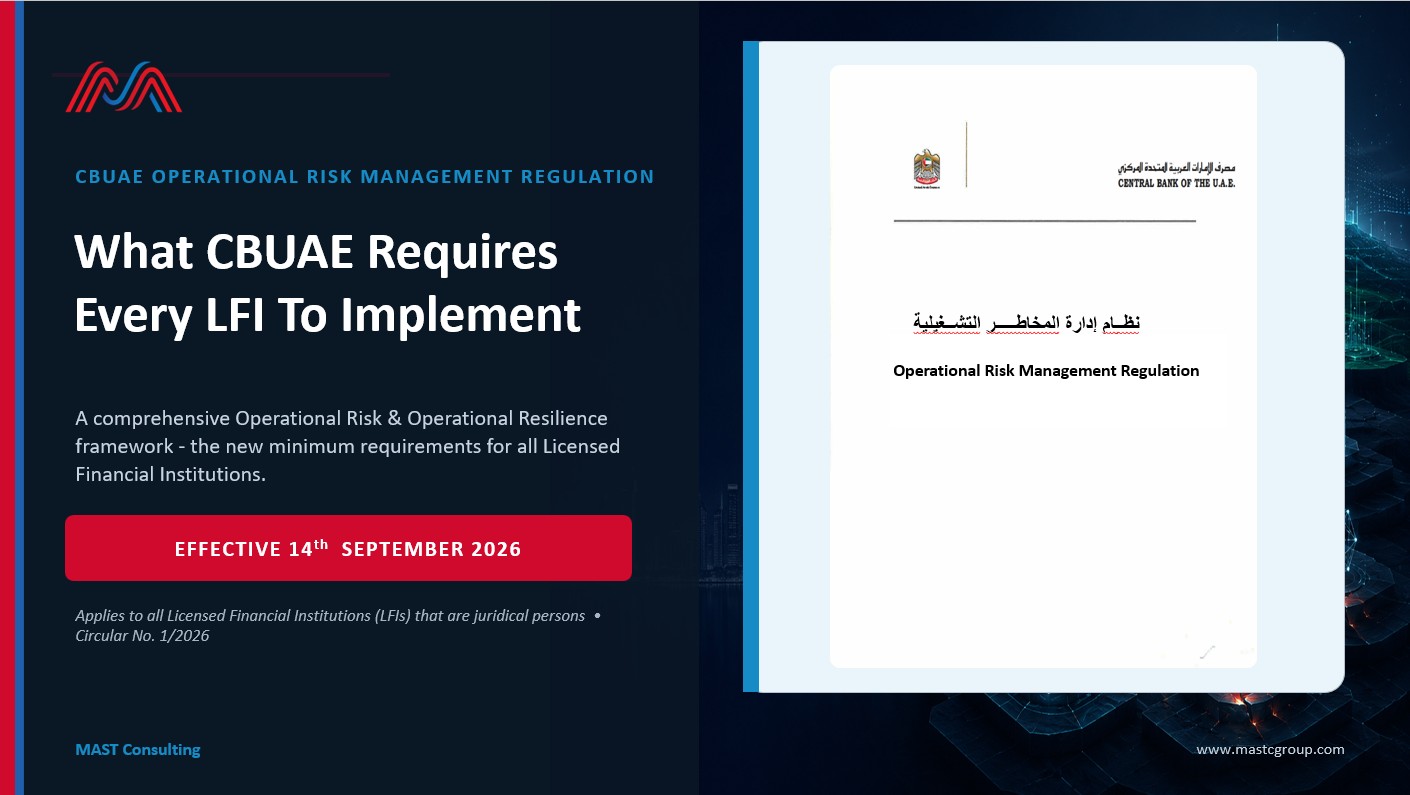
The Central Bank of the UAE (CBUAE) Operational Risk Management Regulation – Circular No. 1/2026 introduces enhanced requirements for Licensed Financial Institutions (LFIs) to establish a comprehensive Operational Risk and Operational Resilience framework. The regulation becomes effective on 14 September 2026.
For LFIs, this means moving beyond traditional risk management and ensuring that operational resilience is embedded across governance, technology, people, processes and third-party relationships.
What Does CBUAE Require?
LFIs are required to establish a well-documented framework integrated with their wider risk management and governance arrangements. Key areas include:
- Governance & Accountability – Board oversight, policies, risk appetite and clear responsibilities.
- Risk Identification & Assessment – Process universe, RCSA, KRIs and loss-event information.
- Internal Controls – Effective controls supported by the three lines of defence.
- Operational Resilience – Identification of Critical Operations and impact tolerances.
The framework must also operationalise ICT and cybersecurity risk management, incident management, business continuity and disaster recovery, change management, third-party and outsourcing risk, and risk data and reporting.
Stronger Focus on Operational Resilience
LFIs must identify and map their Critical Operations, establish impact tolerances and maintain plans to continue those operations through severe but plausible disruptions.
The requirements also strengthen expectations around ICT and cybersecurity resilience, incident response, BCP/DR testing, outsourcing risk and regulatory reporting.
Board & Senior Management Accountability
The regulation places significant responsibility on leadership. The Board is expected to approve and periodically review key Operational Risk and Resilience strategies, policies and risk appetite, while Senior Management is responsible for translating these requirements into effective processes, controls and systems.
How MAST Consulting Can Help
MAST Consulting helps LFIs translate CBUAE requirements into a practical and audit-ready framework through:
Regulatory Gap Assessment | Framework & Governance Design | RCSA & KRI Implementation | Critical Operations Mapping | Operational Resilience | BCM & DR | ICT & Cybersecurity Resilience | Third-Party Risk | Regulatory Reporting | Independent Validation & Training.
Is Your LFI Ready for 14 September 2026?
With the effective date approaching, LFIs should assess their current readiness, identify gaps and establish the required evidence before the regulation takes effect.
MAST Consulting can help your organization assess its current position and build a practical roadmap toward CBUAE Operational Risk Management compliance