Artificial Intelligence (AI) is no longer an emerging technology—it is now a strategic business enabler. Organizations across finance, healthcare, retail, manufacturing, government, and technology sectors are integrating AI into business operations to automate processes, enhance customer experiences, improve decision-making, and drive innovation.
However, successful AI adoption extends beyond deploying powerful models. Organizations must establish effective AI Governance, Risk, and Compliance (AI GRC) practices to ensure AI systems remain secure, ethical, transparent, compliant, and trustworthy.
Without proper governance, AI can expose organizations to regulatory penalties, cybersecurity threats, biased outcomes, privacy violations, and reputational damage.
At MAST Consulting, we help organizations implement comprehensive AI Governance Frameworks that balance innovation with governance, enabling businesses to maximize AI’s value while effectively managing risks.
This comprehensive AI GRC implementation checklist outlines the critical components every organization should implement for responsible AI governance.
- Can organizations simply design their own controls?
- When should a Compensating Control be used?
- Can a Customized Approach replace a Compensating Control?
What is AI GRC?
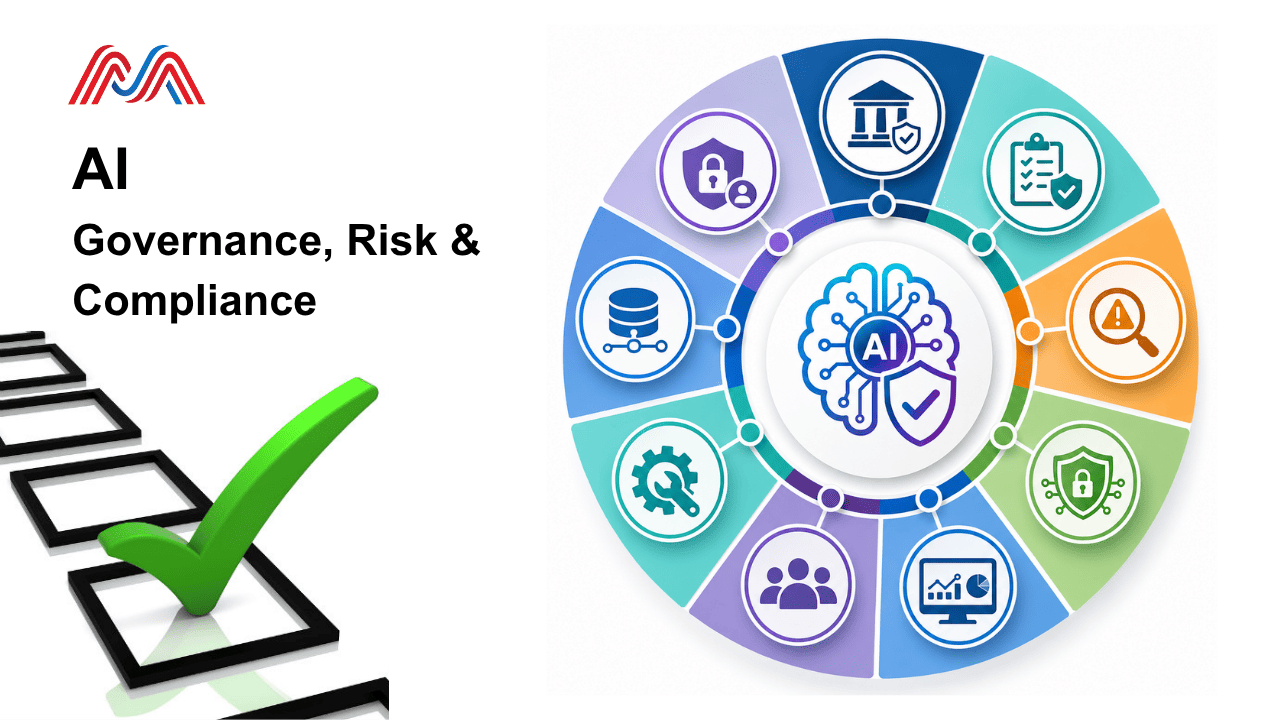
AI Governance, Risk, and Compliance (AI GRC) is a structured approach to managing Artificial Intelligence throughout its lifecycle by integrating governance, cybersecurity, privacy, compliance, ethics, and enterprise risk management.
A mature AI GRC framework ensures AI systems are:
- Secure
- Transparent
- Explainable
- Ethical
- Compliant
- Reliable
- Accountable
Rather than treating governance as a compliance exercise, AI GRC enables organizations to build trustworthy AI that supports long-term business objectives.
Why AI Governance is Critical
As AI becomes embedded into critical business processes, organizations face new challenges including:
- AI bias and discrimination
- Hallucinated or inaccurate outputs
- Data privacy violations
- Intellectual property risks
- AI cyber attacks
- Shadow AI usage
- Lack of accountability
- Regulatory non-compliance
A robust AI Governance Framework minimizes these risks while enabling organizations to innovate responsibly.
AI GRC Implementation Checklist
1. Establish AI Governance
Strong governance provides the foundation for every successful AI initiative.
Organizations should:
- Develop an enterprise AI Governance Policy
- Define approved and prohibited AI use cases
- Establish AI governance committees
- Assign accountability for AI decisions
- Define ethical AI principles
- Create AI governance workflows
- Integrate governance into business processes
A clearly documented governance structure promotes accountability, consistency, and transparency across the AI lifecycle.
2. Align AI with Regulatory Compliance
The regulatory landscape for AI is evolving rapidly, making compliance an ongoing priority.
Organizations should:
- Identify applicable AI and privacy regulations
- Perform AI compliance assessments
- Maintain transparent privacy notices
- Manage user consent effectively
- Document lawful processing activities
- Review third-party AI providers
- Maintain evidence for regulatory audits
Embedding compliance into AI development reduces legal exposure and simplifies future audits.
3. Implement AI Risk Management
AI introduces technical, operational, legal, ethical, and cybersecurity risks that require continuous oversight.
An effective AI Risk Management Framework should include:
- AI risk identification
- Risk assessment methodology
- Risk scoring
- Bias assessments
- Adversarial attack assessments
- Privacy impact analysis
- Continuous risk monitoring
- Risk treatment plans
Integrating AI risks into Enterprise Risk Management (ERM) ensures consistent governance across the organization.
4. Build Privacy by Design and Security by Design
Responsible AI begins with protecting sensitive information.
Organizations should implement:
- Privacy by Design
- Security by Design
- Data minimization
- Privacy Enhancing Technologies (PETs)
- Encryption
- Secure development practices
- User consent management
- Data subject rights management
Embedding privacy and security from the design stage significantly reduces compliance and operational risks.
5. Strengthen AI Data Governance
Data is the foundation of Artificial Intelligence.
Organizations should establish comprehensive AI Data Governance practices including:
- Data inventories
- Data classification
- Data lineage
- Data provenance
- Data quality assessments
- Dataset bias reviews
- AI asset inventories
- Data stewardship
Well-governed data improves AI performance while supporting regulatory compliance.
6. Secure AI Infrastructure
AI environments require modern cybersecurity controls.
Essential security measures include:
- Encryption at rest and in transit
- Role-Based Access Control (RBAC)
- Multi-Factor Authentication (MFA)
- Continuous monitoring
- Security logging
- Threat modelling
- Network segmentation
- Patch management
- Vulnerability management
- Data masking in testing environments
Strong security controls reduce the likelihood of AI compromise and unauthorized access.
7. Monitor AI Throughout Its Lifecycle
AI governance does not stop after deployment.
Organizations should continuously monitor:
- Model accuracy
- Model drift
- Data drift
- AI bias
- Security events
- Compliance status
- AI incidents
- User feedback
Regular audits and monitoring improve AI reliability and ensure ongoing compliance.
8. Build an AI Governance Culture
Technology alone cannot achieve responsible AI.
Organizations should promote:
- AI ethics awareness
- AI security awareness
- Privacy training
- Responsible AI education
- Cross-functional collaboration
- Secure AI development practices
Employees should understand how AI governance contributes to organizational success.
9. Implement AI Governance Technology
Modern AI governance relies on automation.
Organizations should implement tools for:
- AI asset management
- AI model inventory
- Compliance monitoring
- Audit management
- Evidence collection
- AI documentation
- Data lineage visualization
- AI risk dashboards
- Continuous control monitoring
Automation reduces manual effort while improving governance maturity.
Benefits of AI GRC Implementation
Organizations implementing AI GRC experience significant business advantages, including:
- Improved AI Governance
- Stronger AI Security
- Better Regulatory Compliance
- Enhanced AI Transparency
- Reduced Business Risk
- Improved Data Privacy
- Better Audit Readiness
- Greater Customer Trust
- Faster AI Adoption
- Increased Executive Confidence
- Responsible AI Innovation
- Improved Decision-Making.
Why Choose MAST Consulting for AI Governance?
MAST Consulting provides end-to-end AI Governance, Risk, and Compliance services to help organizations implement secure, compliant, and scalable AI programs.
Our AI consulting services include:
- AI Governance Framework Development
- AI GRC Implementation
- AI Risk Assessments
- AI Security Assessments
- AI Compliance Gap Assessments
- AI Policy Development
- AI Governance Roadmaps
- AI Lifecycle Governance
- AI Privacy Assessments
- AI Security Architecture Reviews
- AI Awareness & Training
- AI Internal Audits
Our consultants combine expertise in cybersecurity, governance, risk management, privacy, compliance, and information security to help organizations adopt AI responsibly while meeting business and regulatory objectives.