Introduction
As financial institutions increasingly rely on digital technologies, cloud services and interconnected systems, cybersecurity has become a critical regulatory and business priority.
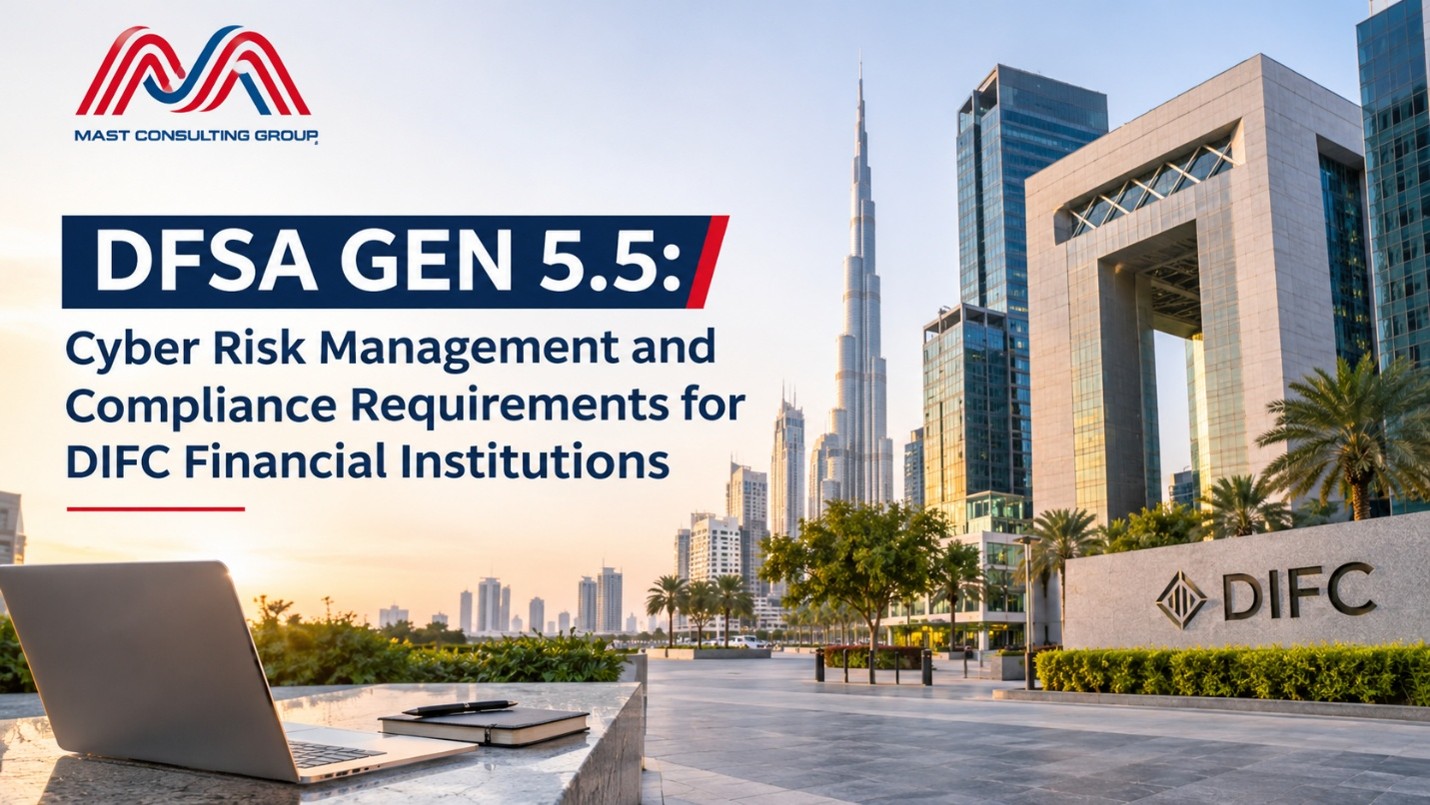
The Dubai Financial Services Authority (DFSA) has established cybersecurity requirements under General Module (GEN) Section 5.5 – Cyber Risk Management, aimed at strengthening cyber resilience among regulated financial institutions operating within the Dubai International Financial Centre (DIFC).
DFSA GEN 5.5 emphasises effective cybersecurity governance, risk assessment, protection of information assets, incident response and third-party risk management.
For regulated firms, compliance requires more than implementing technical security controls. It involves establishing a structured approach to identifying, managing and monitoring cybersecurity risks.
What Is DFSA GEN 5.5?
DFSA GEN 5.5 is the Cyber Risk Management section of the DFSA Rulebook’s General Module.
It establishes regulatory requirements for Authorised Persons to manage cyber risks through appropriate governance arrangements, policies, procedures and security controls.
The requirements are intended to help organisations protect critical ICT assets, minimise cyber threats and maintain operational resilience.
The framework covers several key areas:
- Cybersecurity governance and accountability.
- Cyber Risk Management Framework.
- ICT asset identification and risk assessment.
- Technical and operational security controls.
- Third-party cybersecurity risk management.
- Cyber incident detection, response and recovery.
- Cyber incident reporting to the DFSA.
The specific obligations applicable to an organisation depend on its regulatory classification and relevant DFSA Rulebook provisions.
Key Requirements of DFSA GEN 5.5
- Cyber Risk Management Framework
Under GEN 5.5.2, regulated firms must establish and maintain a documented Cyber Risk Management Framework approved by their Governing Body.
The framework should be integrated with the organisation’s overall risk management arrangements and reviewed at least annually.
Key implementation areas include cybersecurity policies, governance structures, risk ownership, management reporting and periodic reviews.
- Cybersecurity Governance and Accountability
Effective cyber risk management requires active oversight from the Governing Body and senior management.
Organisations should establish clearly defined cybersecurity responsibilities, reporting mechanisms and escalation procedures.
Cybersecurity risks, incidents and control weaknesses should be communicated to relevant management stakeholders to support informed decision-making.
- ICT Asset Identification and Cyber Risk Assessment
GEN 5.5.5 addresses the identification and classification of ICT assets and the assessment of associated cyber risks.
Financial institutions should maintain updated ICT asset inventories and conduct regular cybersecurity risk assessments covering:
- Critical applications, infrastructure and information assets.
- Cyber threats and vulnerabilities.
- Existing security controls and their effectiveness.
- Potential business impacts.
- Residual risks and treatment requirements.
Assessment results should support risk prioritisation, ownership and appropriate remediation activities.
- Protection of ICT Assets
DFSA GEN 5.5 includes requirements relating to the protection of ICT assets against cybersecurity threats.
Relevant security measures include:
- Identity and access management.
- Network and infrastructure security.
- Vulnerability and patch management.
- Malware protection and security monitoring.
- Data protection and encryption.
- Backup and recovery arrangements.
- Secure system development and change management.
Organisations should implement controls appropriate to their technology environment, operational complexity and cybersecurity risk exposure.
- Third-Party Cyber Risk Management
Financial institutions increasingly depend on cloud providers, technology vendors and outsourced ICT service providers.
These arrangements introduce cybersecurity risks that require appropriate oversight.
Organisations should conduct supplier risk assessments, establish contractual security requirements, monitor third-party security performance and maintain suitable incident notification arrangements.
Outsourcing technology services does not eliminate a regulated firm’s responsibility for managing applicable cybersecurity obligations.
- Cyber Incident Management and Reporting
GEN 5.5 addresses cybersecurity monitoring, incident response, recovery and regulatory notification.
Financial institutions should maintain documented incident response procedures covering incident identification, escalation, containment, investigation and recovery.
Material Cyber Incidents must be reported to the DFSA in accordance with applicable regulatory requirements.
Incident response arrangements should be periodically tested and improved based on lessons learned.
DFSA GEN 5.5 and ISO/IEC 27001:2022
ISO/IEC 27001:2022 provides an internationally recognised framework for managing information security risks.
Many ISO 27001 requirements and Annex A controls can support the implementation of DFSA GEN 5.5.
DFSA GEN 5.5 Area | Relevant ISO 27001:2022 Controls |
Cybersecurity Governance | Clause 5 – Leadership; A.5 Organisational Controls |
Cyber Risk Assessment | Clauses 6.1.2 and 8.2 |
ICT Asset Management | A.5.9 – Inventory of Information and Other Associated Assets |
Access Management | A.5.15–A.5.18 |
Vulnerability Management | A.8.8 – Management of Technical Vulnerabilities |
Supplier Security | A.5.19–A.5.23 |
Incident Management | A.5.24–A.5.28 |
ICT Continuity | A.5.29–A.5.30 |
Although ISO 27001 implementation provides a strong foundation for cybersecurity governance, ISO 27001 certification does not automatically establish compliance with DFSA GEN 5.5.
Organisations must separately evaluate applicable DFSA regulatory requirements and maintain evidence demonstrating compliance.
Common DFSA GEN 5.5 Compliance Challenges
Financial institutions may face several challenges when implementing the framework.
Cybersecurity Governance: Unclear responsibilities, insufficient management oversight and fragmented cybersecurity processes.
ICT Asset Management: Incomplete asset inventories and limited visibility of critical systems and technology dependencies.
Cyber Risk Assessment: Inconsistent risk assessments, inadequate risk ownership and insufficient evaluation of residual risks.
Third-Party Security: Limited supplier cybersecurity assessments and monitoring of outsourced technology services.
Incident Response: Inadequate incident response testing, escalation procedures or regulatory reporting arrangements.
Compliance Evidence: Difficulty demonstrating the effectiveness of implemented controls through documented records and periodic reviews.
Addressing these challenges requires coordinated governance, risk management and technical security improvements.
How to Prepare for DFSA GEN 5.5 Compliance
Financial institutions can adopt a structured approach to strengthen compliance readiness.
- Conduct a Gap Assessment: Evaluate existing cybersecurity controls, policies and procedures against applicable DFSA GEN 5.5 requirements.
- Establish a Cyber Risk Management Framework: Define governance arrangements, responsibilities, policies and risk management procedures.
- Perform Cyber Risk Assessments: Identify critical ICT assets, threats, vulnerabilities and existing controls, and maintain an actionable risk register.
- Strengthen Security Controls: Review access management, vulnerability management, monitoring, third-party security and incident response capabilities.
- Develop a Remediation Roadmap: Prioritise identified gaps, assign responsibilities and establish implementation timelines.
- Implement Continuous Monitoring: Conduct periodic control reviews, management reporting, risk assessments and compliance evidence reviews.
A proactive approach helps organisations strengthen cybersecurity resilience while maintaining regulatory readiness.
How MAST Consulting Group Can Help
At MAST Consulting Group, we help financial institutions strengthen cybersecurity governance, manage cyber risks and align their security programmes with regulatory requirements.
Our DFSA GEN 5.5 consulting services include:
- DFSA GEN 5.5 Gap Assessment: Evaluate cybersecurity policies, processes and controls against applicable regulatory requirements.
- Cyber Risk Management Framework Development: Establish governance structures, risk management procedures and supporting documentation.
- Cybersecurity Risk Assessment: Identify cyber threats, vulnerabilities, control weaknesses and risk treatment priorities.
- ISO 27001 and DFSA Control Mapping: Align existing information security controls with DFSA GEN 5.5 requirements.
- Third-Party Cyber Risk Management: Assess technology supplier risks and outsourced ICT service arrangements.
- Incident Response and Cyber Resilience: Develop incident response procedures, escalation mechanisms and recovery arrangements.
- Compliance Remediation Support: Prepare practical remediation plans, compliance evidence registers and continuous improvement programmes.
Our approach focuses on developing practical, sustainable cybersecurity controls that support regulatory compliance and long-term operational resilience.
Looking to strengthen your DFSA GEN 5.5 compliance readiness?
MAST Consulting Group can help your organisation assess existing cybersecurity controls, identify compliance gaps and develop an actionable roadmap for cyber risk management.
Contact MAST Consulting Group to discuss your DFSA Cyber Risk Management requirements.