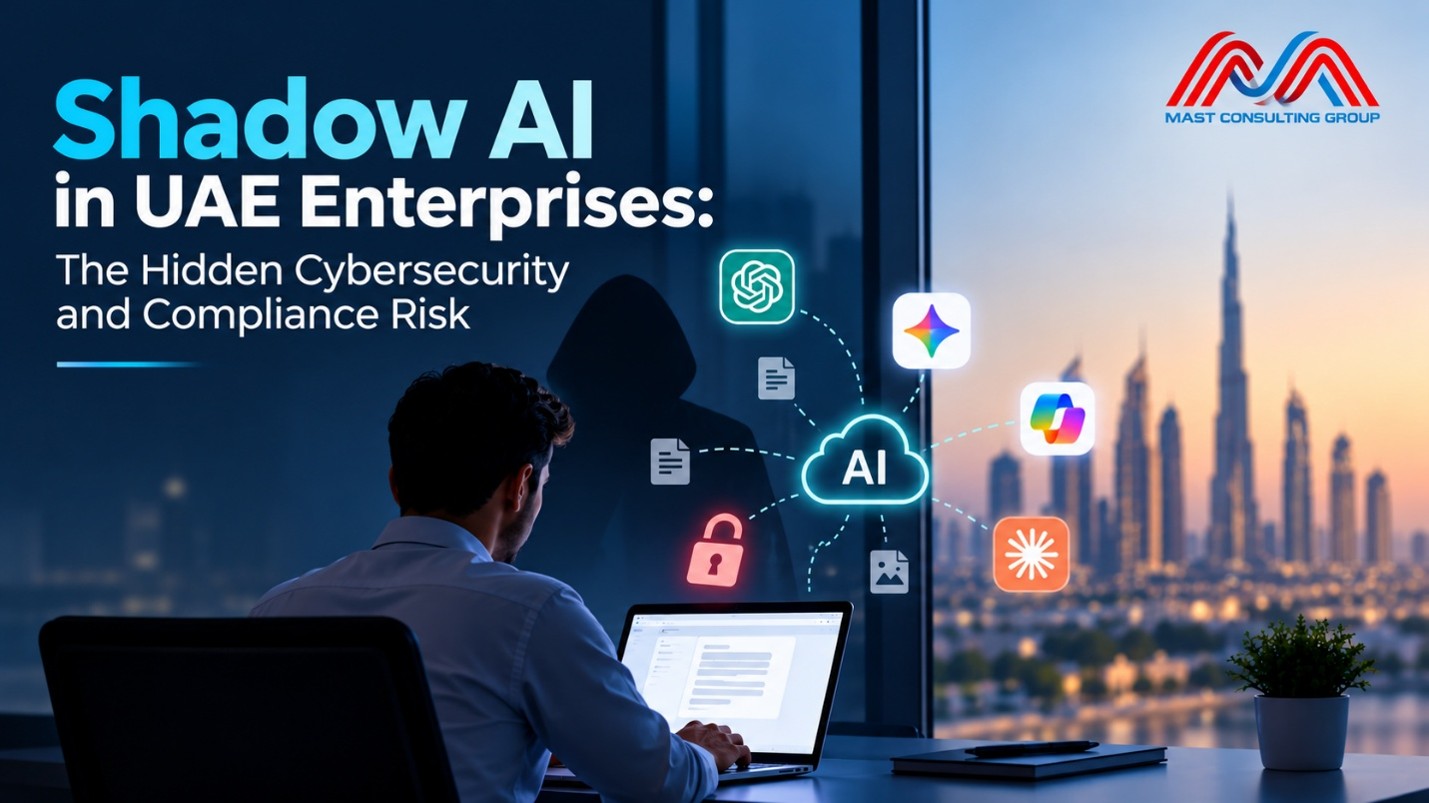
As artificial intelligence transforms business operations across the UAE, a new cybersecurity challenge is emerging: employees using AI tools without organisational approval or oversight
Artificial Intelligence (AI) is becoming an essential part of modern business operations. From drafting emails and analysing documents to developing software and automating workflows, AI tools are helping employees improve productivity and efficiency.
However, rapid AI adoption is introducing a growing concern for organisations: Shadow AI.
When employees use unapproved AI applications to process business information, organisations may lose visibility and control over sensitive data, cybersecurity risks and regulatory obligations.
For UAE businesses embracing digital transformation, managing Shadow AI is becoming an important part of cybersecurity and AI governance.
What Is Shadow AI?
Shadow AI refers to the use of artificial intelligence tools, applications or services within an organisation without the necessary approval, security assessment or oversight from IT, information security or management.
Unlike officially approved enterprise AI solutions, Shadow AI may operate outside established security controls and governance processes.
Common examples include:
- Employees uploading confidential business documents to personal AI chatbot accounts.
- HR teams using unapproved AI tools to screen resumes containing personal information.
- Developers sharing proprietary source code with public AI coding assistants.
- Finance teams uploading customer or financial information to AI analysis platforms.
- Employees connecting AI assistants to corporate email, cloud storage or internal applications without authorisation.
While these activities may be intended to improve productivity, they can expose organisations to security, privacy and compliance risks.
Key Cybersecurity and Compliance Risks of Shadow AI
- Sensitive Data Leakage
Employees may unknowingly share confidential information with external AI platforms.
This can include customer records, financial reports, employee information, contracts, intellectual property and other sensitive business data.
Without proper controls, organisations may not know where this information is processed, stored or retained.
- Data Privacy and Regulatory Compliance
The UAE Personal Data Protection Law (PDPL), Federal Decree-Law No. 45 of 2021, establishes requirements for protecting personal data, including obligations relating to processing, confidentiality and cross-border data transfers.
Unapproved AI tools may create compliance concerns when employees process personal data without appropriate authorisation, safeguards or contractual arrangements.
Organisations must also consider any applicable sector-specific requirements and data protection rules in jurisdictions such as DIFC and ADGM.
- Lack of Visibility and Control
Traditional IT asset inventories may not capture employees’ use of external AI platforms.
Without visibility into the tools being used and the information being processed, security teams may struggle to identify risks, investigate incidents or enforce security policies.
- Intellectual Property and Confidentiality Risks
Uploading proprietary code, internal strategies, client deliverables or confidential business information to unapproved AI services can introduce intellectual property and contractual confidentiality risks.
Organisations should understand the data-handling terms and security controls of AI service providers before authorising their use.
- Inaccurate Outputs and Business Decisions
AI-generated content may contain inaccurate, incomplete or misleading information.
When employees rely on unverified AI outputs for financial analysis, regulatory documentation, customer communications or business decisions, errors may create operational and reputational consequences.
- Unauthorised AI Integrations and Access
AI assistants and autonomous agents may connect to business applications, cloud platforms and internal data repositories.
Without appropriate access controls and oversight, these integrations may create excessive permissions, unintended data exposure and opportunities for misuse.
How Can UAE Organizations Manage Shadow AI?
Managing Shadow AI does not necessarily mean prohibiting employees from using artificial intelligence.
A more effective approach is to establish clear governance, approved tools and appropriate security controls that enable responsible AI adoption.
- Identify AI Tools Used Across the Organisation
Conduct an AI usage assessment to identify applications, platforms and integrations being used by employees.
- Establish an AI Acceptable Use Policy
Define permitted and prohibited AI activities, approval requirements, employee responsibilities and restrictions on sharing confidential information.
- Perform AI Security and Privacy Risk Assessments
Assess AI tools based on data sensitivity, security capabilities, vendor practices, regulatory obligations and potential business impact.
- Implement Data Protection and Access Controls
Apply appropriate data classification, data loss prevention, identity and access management, and monitoring controls to reduce unauthorised data exposure.
- Provide Approved Enterprise AI Solutions
Where appropriate, provide secure, approved AI tools that meet business needs and reduce employees’ reliance on unapproved alternatives.
- Conduct Employee Awareness and Training
Educate employees about Shadow AI risks, safe prompting practices, confidential data handling and the importance of using authorised AI applications.
- Establish Continuous Monitoring and Governance
Regularly review AI usage, evaluate emerging risks, maintain an AI system inventory and update security controls as technologies and business requirements evolve.
How ISO 42001, ISO 27001 and ISO 27090 Support Shadow AI Governance
International standards provide valuable frameworks for organisations seeking to strengthen AI governance and cybersecurity.
Standard | Relevance to Shadow AI |
ISO/IEC 42001:2023 | Establishes an Artificial Intelligence Management System (AIMS) to support responsible AI governance, risk management and oversight. |
ISO/IEC 27001:2022 | Establishes an Information Security Management System (ISMS) to protect information assets and manage cybersecurity risks. |
ISO/IEC 27090:2026 | Provides guidance on addressing security threats and compromises affecting AI systems. |
Together, these standards can support a coordinated approach to AI governance, information security and AI-specific risk management.
How MAST Consulting Group Can Help
At MAST Consulting Group, we help organisations strengthen their cybersecurity, governance, risk management and AI security practices.
Our consulting services can support UAE enterprises in identifying and managing Shadow AI risks through:
Shadow AI Risk and Gap Assessment
Identify unapproved AI usage, evaluate associated security and compliance risks, and assess gaps in existing governance and security controls.
AI Governance and ISO/IEC 42001 Consulting
Support the establishment of AI governance frameworks, responsibilities, policies, risk assessments and Artificial Intelligence Management Systems.
Cybersecurity and ISO/IEC 27001 Consulting
Strengthen information security controls, data protection practices, access management and cybersecurity risk management.
AI Acceptable Use Policies and Procedures
Develop practical policies and procedures defining acceptable AI usage, approval processes, data handling requirements and employee responsibilities.
Compliance Readiness and Continuous Improvement
Support compliance reviews, documentation, control assessments, corrective action planning and ongoing improvement of AI governance practices.
Our approach focuses on helping organisations adopt AI securely while maintaining appropriate oversight, accountability and regulatory awareness.
Conclusion: Secure AI Adoption Starts with Governance
Shadow AI is an emerging challenge for organisations across the UAE.
While AI technologies offer significant opportunities for innovation and productivity, uncontrolled adoption can introduce cybersecurity, privacy, compliance and operational risks.
The objective is not to stop AI innovation, but to ensure that AI adoption is secure, responsible and aligned with business objectives.
By establishing clear policies, identifying unapproved AI usage, assessing risks and implementing effective governance controls, organizations can strengthen their cybersecurity posture while continuing to benefit from artificial intelligence.
Is Your Organization Prepared to Manage Shadow AI?
MAST Consulting Group supports organizations in strengthening AI governance, cybersecurity and compliance through structured assessments, international standards and practical risk management solutions.
Contact MAST Consulting Group to discuss your organization’s Shadow AI risks and AI governance readiness.