Organizations process significant volumes of personal data every day, including customer names, contact details, Emirates ID information, financial records, and employee data.
A personal data breach does not always result from a cyberattack. Sometimes, a simple operational error—such as sending an email to the wrong recipient—can create a serious privacy incident.
Let’s look at a practical scenario and understand how the UAE Personal Data Protection Law (PDPL) becomes relevant.
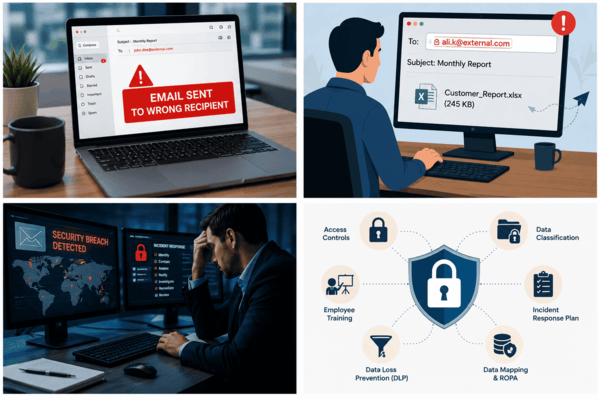
Scenario: One Email Sent to the Wrong Person.
Consider a UAE-based organization where an employee exports a customer report containing names, contact details, Emirates ID information and transaction data.
While sending the report internally, Outlook suggests a similar external email address. The employee selects the wrong recipient and sends the attachment outside the organization.
Within minutes, the mistake is identified.
The organization must now determine:
- What personal data was exposed?
- How many individuals were affected?
- Was sensitive information included?
- Was the attachment opened, downloaded or forwarded?
- Can access be restricted or recalled?
- Is regulatory or customer notification required?
What appeared to be a simple human error has potentially become a personal data breach.
What Does the UAE PDPL Say About Personal Data Breaches?
Federal Decree-Law No. 45 of 2021 establishes the UAE’s federal personal data protection framework.
Article 9 requires Controllers to notify the relevant Bureau where a personal data breach would prejudice the privacy, confidentiality or security of personal data, subject to the applicable notification requirements. Notification to affected data subjects may also be required.
Organizations therefore need an established process to:
Identify → Contain → Assess → Investigate → Notify → Remediate
The Real Question: Was It Just Human Error?
While the employee may have triggered the incident, organizations should look beyond the immediate cause.
Key questions include:
- Did the employee need access to all customer records?
- Was all the information in the report necessary?
- Why could sensitive information be emailed externally?
- Were Data Loss Prevention controls implemented?
- Was the information appropriately classified?
- Were access rights reviewed?
- Were employees trained on personal data handling?
A breach caused by human error can become significantly more serious when privacy governance and technical controls are weak.
Controls That Can Reduce the Risk
An effective UAE PDPL compliance program should combine governance, people, processes and technology.
Key measures may include:
- Role-based access controls
- Data classification
- Data Loss Prevention
- Data minimization
- Privacy and security awareness
- Personal Data Breach Management procedures
Organizations should also understand where personal data is stored and how it moves across systems, environments and third parties.
This requires effective data discovery, data mapping and a Record of Processing Activities (ROPA).
UAE PDPL Compliance Goes Beyond a Privacy Policy
Publishing a privacy policy on a website does not by itself create an effective privacy management program.
Depending on the organization’s activities and applicable requirements, UAE PDPL readiness may involve:
Gap Assessment → Data Mapping → ROPA → Privacy Notices → Consent → Data Subject Rights → DPIA → Data Retention → Third-Party Privacy → Cross-Border Transfers → Breach Management → Security Controls → Awareness
Privacy should be embedded into day-to-day business operations rather than treated as a standalone compliance exercise.
Where Should Organizations Start?
A practical starting point is a structured UAE PDPL Gap Assessment to evaluate existing governance, documentation, processes and controls.
A simple approach is:
UAE PDPL Requirement → Existing Control → Evidence → Compliance Status → Gap → Privacy Risk → Recommended Action
This provides management with a clear view of the current compliance position and a prioritized remediation roadmap.
How MAST Consulting Can Help
MAST Consulting supports organizations across the UAE in establishing practical and sustainable privacy compliance programs.
Our UAE PDPL consulting services can support organizations with:
- UAE PDPL Gap Assessments
- Personal Data Discovery and Mapping
- ROPA Development
- Data Protection Impact Assessments (DPIAs)
- Privacy Policies and Framework
- Data Subject Rights Management
- Data Breach Management
- Third-Party Privacy Assessments
- Cross-Border Data Transfer Reviews
- Privacy Awareness Training and Ongoing Compliance Support
Our approach goes beyond documentation.
We work with organizations to understand how personal information actually moves across their people, processes, applications, infrastructure, cloud environments and third parties, and help translate regulatory requirements into practical controls and evidence.
Disclaimer: This article is intended for general informational purposes only and does not constitute legal advice. Organizations should assess the UAE PDPL and any sector-specific data protection requirements applicable to their activities.