An enterprise invests in a cutting-edge GRC platform. The dashboards are impressive. The reports look flawless. Six months later, a regulatory audit takes place. The organization cannot produce a single complete audit trail. Policies are outdated. Roles and responsibilities are unclear.
The tool performed exactly as designed. The compliance program did not.
This scenario is playing out across the UAE with alarming frequency. Too many organizations mistake implementing a tool for implementing a framework. A tool does not create governance. It does not define accountability, maintain policies, or embed compliance into daily operations. That distinction determines whether you pass a regulatory inspection or face regulatory action.
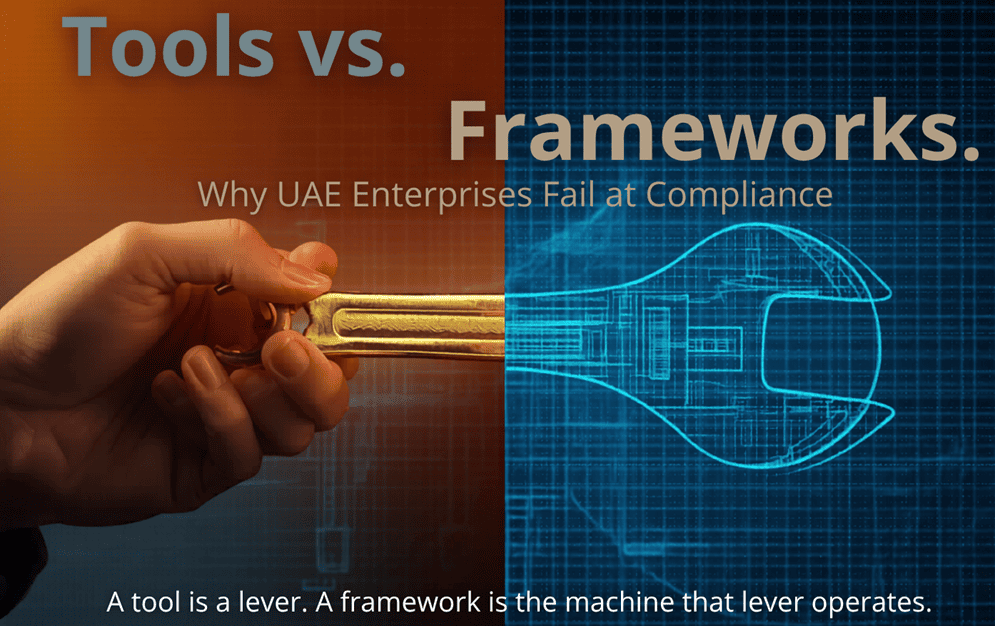
A framework answers: “What should we do, who owns it, how do we monitor it, and how do we prove it works?”
A tool answers: “How do we do this task faster?”
The first builds a program. The second improves efficiency
The UAE Regulatory Reality
UAE regulators do not mandate specific tools. They mandate outcomes.
- CBUAE requires robust governance and requires compliance with the Information Assurance Framework (IAF), not a specific SIEM/SOC vendor.
- DESC requires compliance with the Information Security Regulation (ISR), not a particular GRC platform
- PDPL requires both appropriate technical measures and organizational measures
A regulator does not ask, “Which tool did you buy?”
They ask: “Show me your risk assessment process. Show me your policy review cycle. Show me evidence of management oversight. Show me who is accountable. Now prove that you followed it.”
A tool alone cannot answer those questions. A framework can.
Why Tools Fail Without Frameworks
Without a framework, even the most sophisticated GRC platform cannot answer fundamental questions such as
- Who owns risks?
- Which standards and regulations apply?
- Who is responsible for approving exceptions?
A framework provides the governance structure, defined roles, documented processes, review cycles, and evidence requirements that give a tool meaning. The tool then supports the framework by automating tasks, storing records, and generating reports. A well-implemented framework can function effectively even with spreadsheets and shared drives.
Regulators accept manual processes. They do not accept the absence of processes.
The distinction becomes clear when you map what frameworks define versus what tools enable, as illustrated below:
Domain | What a Framework Provides | What a Tool Provides |
Information Security Management | Defines policies, risk methodology, ownership, review cycles, and evidence requirements. Creates consistency and accountability. | Automates control tracking, evidence storage, reminders, and report generation. |
Cybersecurity Risk Management | Defines how risks are identified, assessed, treated, accepted, and escalated. Establishes risk appetite and ownership. | Maintains risk registers, calculates scores, visualizes heat maps, and tracks remediation. |
Regulatory Compliance | Defines which regulations apply, what controls are required, who is accountable, and how compliance is demonstrated. | Maps controls to regulations, tracks gaps, stores evidence, and produces compliance dashboards. |
IT Governance | Defines decision-making structure, roles, responsibilities, approvals, and oversight processes. | Automates workflows, records approvals, tracks KPIs, and generates management reporting. |
IT Service Management | Defines how incidents, changes, problems, and requests should be handled and who is responsible. | Creates tickets, routes approvals, tracks SLAs, and provides operational metrics. |
Internal Audit & Assurance | Defines audit scope, frequency, methodology, reporting, and follow-up requirements. | Schedules audits, stores findings, tracks remediation, and generates audit trails. |
Business Continuity & Disaster Recovery | Defines recovery objectives, crisis roles, testing requirements, and escalation procedures. | Stores plans, schedules tests, sends alerts, and tracks recovery actions. |
Third-Party Risk Management | Defines how vendors are assessed, approved, monitored, and reviewed. | Tracks assessments, sends questionnaires, stores contracts, and monitors issues. |
Identity & Access Management | Defines access principles, segregation of duties, approval authority, and review cycles. | Automates provisioning, deprovisioning, access reviews, and logging. |
Vulnerability & Patch Management | Defines how vulnerabilities are prioritized, who owns remediation, and required timelines. | Detects vulnerabilities, tracks patches, prioritizes issues, and measures closure rates. |
Incident Response | Defines incident classification, escalation paths, response roles, communication, and lessons learned. | Detects incidents, creates cases, tracks actions, and produces investigation reports. |
Data Protection & Privacy | Defines data classification, retention, lawful use, and responsibilities for protecting sensitive data. | Discovers sensitive data, monitors usage, enforces retention, and generates privacy reports. |
The Right Sequence
The correct approach for UAE enterprises is:
- Adopt a framework (ISO 27001 + UAE IAF)
- Implement it manually first to understand your processes
- Identify genuine pain points based on manual operation
- Select tools that serve your framework never the reverse
Conclusion
A tool is a lever. A framework is the machine that the 0lever operates. Buying a lever without understanding the machine moves nothing except your budget.
For UAE enterprises, the path is clear: adopt a recognized framework, implement it manually first, then add tools to address specific inefficiencies. Organizations that follow this sequence will pass regulatory inspections. Those that do not will keep buying expensive tools while failing to answer the regulator’s most basic question:
“Show me your framework, not your receipt.”