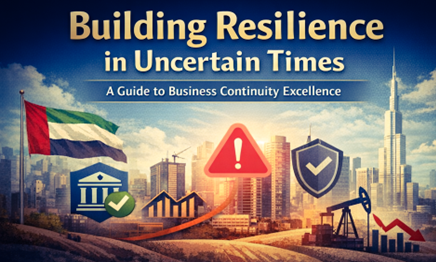
In an increasingly uncertain geopolitical environment, business continuity is no longer a procedural exercise; it is a strategic resilience capability. For organizations in critical sectors across the UAE, the ability to sustain operations during disruption is directly linked to regulatory expectations, national stability, and stakeholder trust.

Traditional continuity plans designed for isolated incidents are no longer sufficient. Today’s disruptions are complex, interconnected, and often simultaneous, testing not just systems but leadership, governance, and the ability to operate under pressure
Regulatory Expectation

In the UAE, regulators are increasingly shifting their focus from documented compliance to demonstrable resilience and assured operational readiness. Authorities such as the National Emergency Crisis and Disaster Management Authority (NCEMA) and the Dubai Electronic Security Center (DESC) expect organizations, especially in critical sectors, to sustain essential services under adverse conditions.

The expectation is no longer limited to having a business continuity framework in place. Instead, regulators require organizations to demonstrate that critical operations can continue effectively during disruptions, including crises involving multiple simultaneous failures. This means organizations must be able to demonstrate:

Resilience of critical services under stress conditions
Preparedness of governance and leadership to respond in real time
Continuity of operations despite dependency failures (technology, vendors, workforce)
Scenario-tested readiness, not theoretical planning
Alignment with national resilience objectives and sector-specific mandates
Ultimately, regulatory scrutiny is shifting toward one key question: Can the organization maintain operational continuity when it matters most?

What Organizations Need to Do

To meet evolving regulatory expectations, organizations must translate resilience requirements into practical, embedded capabilities. The focus should be on building the ability to operate through disruption not just documenting response plans.
Key priorities include:

Define and prioritize critical services to ensure focus on what must be sustained at all times
Embed resilience into governance structures, with clear executive ownership and decision-making authority
Map and manage dependencies across technology, third parties, facilities, and workforce
Integrate BCM with cybersecurity, IT resilience, and operational risk management
Implement regular, scenario-based testing that reflects real-world crisis conditions
Establish continuous monitoring and improvement mechanisms to adapt to evolving threats

Organizations that succeed are those that treat resilience as an ongoing capability, embedded into strategy and operations not as a periodic compliance activity.

A Working ISO 22301, Not Just Certification

ISO 22301 provides a globally recognized framework for building an effective Business Continuity Management System (BCMS). However, its value lies in implementation—not certification alone.

A working ISO 22301 framework enables organizations to:
Establish governance and accountability
Prioritize critical operations and recovery strategies
Continuously test and improve response capabilities
Demonstrate resilience to regulators and stakeholders
In the UAE context, ISO 22301 is most effective when aligned with NCEMA and sector-specific regulatory expectations, making it a practical resilience operating model rather than a checkbox exercise.

How MAST Can Help

MAST supports organizations in building practical, regulator-aligned resilience capabilities through:

BCMS design and ISO 22301 implementation
Certification readiness and gap assessments
Regulatory compliance and advisory
Crisis management and scenario planning
Cyber and operational resilience integration

We help organizations move from documented compliance to real operational resilience, ensuring they can sustain critical services when it matters most.
When Disruption Strikes, Will You Be Ready?
Speak to Our Experts.