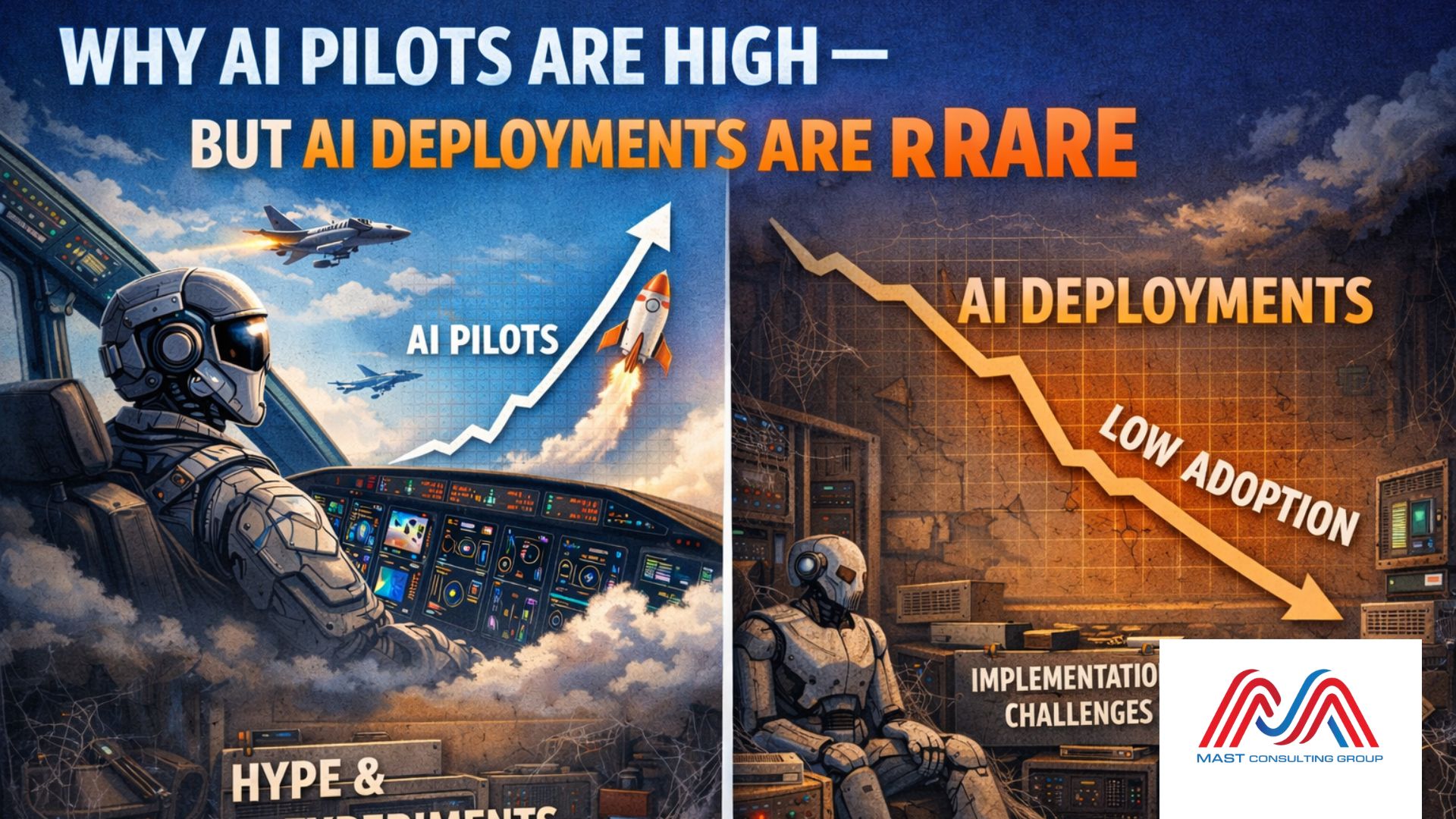
Last week, I had the opportunity to sit with some of the UAE’s most forward-thinking leaders during an MIT-hosted roundtable. As expected, AI dominated the conversation. But unlike many discussions that get lost in hype, this one focused on a critical truth: most AI initiatives never make it past the pilot stage.
MIT research shows that nearly 95 percent of AI pilot projects fail to reach production. This is a staggering figure when we consider how aggressively organizations are investing in AI across government, financial services, and enterprise sectors.
To understand why this happens, we must look at the structural blockers that keep AI stuck at the pilot phase instead of becoming real, operational deployments.
Strategy and Infrastructure Are Not Speaking the Same Language
Many AI projects begin with a strong vision. The business case is clear, the benefits are compelling, and the leadership is excited. But when the underlying infrastructure is not prepared to support AI at scale, the pilot loses momentum.
Pilots often run in isolated sandboxes where everything works smoothly. The challenge begins when integration with core systems, legacy platforms, security controls, and operational workflows becomes necessary.
Real AI success requires infrastructure readiness to be embedded within the strategy from day one. Legacy environments often need architectural uplift, operational redesign, and new governance structures before AI can operate reliably.
A successful pilot is not the win; a stable enterprise-grade deployment is the real success.
Compliance Comes in Too Late—and Becomes a Roadblock
Compliance, governance, and auditability are frequently underestimated during the pilot phase. However, in regulated sectors and government entities, compliance is not optional—it is foundational.
When data protection, model explainability, audit logs, consent rules, and regulatory approvals are reviewed only after the pilot, structural gaps emerge. These gaps often require architectural rework, delaying deployment or halting it entirely.
Compliance cannot be bolted on later. AI must be designed to be compliant from the start.
The Explainability Gap: Business-Led but Technically Detached
AI initiatives usually begin with a strong business problem, which is good. But challenges arise when technical architecture, integration paths, operational workflows, and model explainability are introduced too late.
An AI system can generate promising results during a pilot, yet the organization may still be unable to explain how it works, how it integrates, or how it will be maintained. When teams cannot articulate the “how,” the project remains stuck in experimentation mode.
AI must be more than a powerful idea. It must be explainable, maintainable, and architecturally sustainable
The Ownership Void: The Biggest Reason AI Pilots Fail
Across all the challenges, one stands out as the single most significant cause of AI project failures: the absence of clear ownership.
AI initiatives span business teams, IT, data engineering, cybersecurity, and compliance. But without one accountable owner responsible for governance, scaling decisions, lifecycle management, and operational continuity, the project loses direction after the pilot.
Ownership is what transforms AI from a concept into an organizational capability. Without it, pilots remain pilots—no matter how promising they look.
The Real Measure of AI Success: Deployment, Not Pilots
AI is past the experimental stage. Across the UAE and globally, it is becoming an operational layer—just like the internet did during its transformative era.
To reduce the alarming rate of AI pilot failures, organizations must evaluate every AI initiative against four essential pillars before starting:
Scalability – Can this system operate reliably at enterprise scale?
Auditability – Can every decision and output be traced and validated?
Explainability – Can stakeholders understand, trust, and govern the system?
Ownership – Is there clear accountability for outcomes and ongoing management?
AI maturity is not defined by how many pilots an organization launches. It is defined by how many AI solutions are successfully deployed, adopted, and sustained